Introduction
Welcome to the second episode of the «CRAZY PLOTTER» series!
In the previous episode, I talked about my method for plotting my novels, which you can find right here in case you missed it:

A few weeks ago, I was having trouble keeping track of time in the story, so I improvised and created a method to avoid getting lost in time and space. This method, however, was based on the simple concept of pre-chaptering. And since I don’t want to bore my readers with the same thing twice, I recommend you go and take a quick look at the previous episode before continuing to read this one.
That being said, let’s continue.
Promoting physical touch with your novel
I suppose you can do your timeline plotting digitally, but most of us already write in front of a screen, so why not find ways to give our eyes a rest in other aspects of the writing process?
Since I’ve had access to a keyboard and a computer, I’ve rarely gone back to writing stories on paper. I love the experience of typing on a keyboard; I like that kind of sensory stimulation. However, the physical need for other sensory experiences remains: the friction of the pen in your hand, the smell and feel of the paper. I wouldn’t trade writing my novels on a laptop for anything; it’s simple, effective, and useful in more than a dozen ways. But we can’t let our bodies forget their humanity.
That’s why I’ll explain how I do it physically.
If you prefer to do it digitally, go for it! You’d just need to find a way to implement my concept in a different system, which isn’t really difficult. I bet there’s more than one digital tool that can be adapted to your needs.
You're going to need...
Colored pencils/crayons
A calendar or grid notebook
The calendar
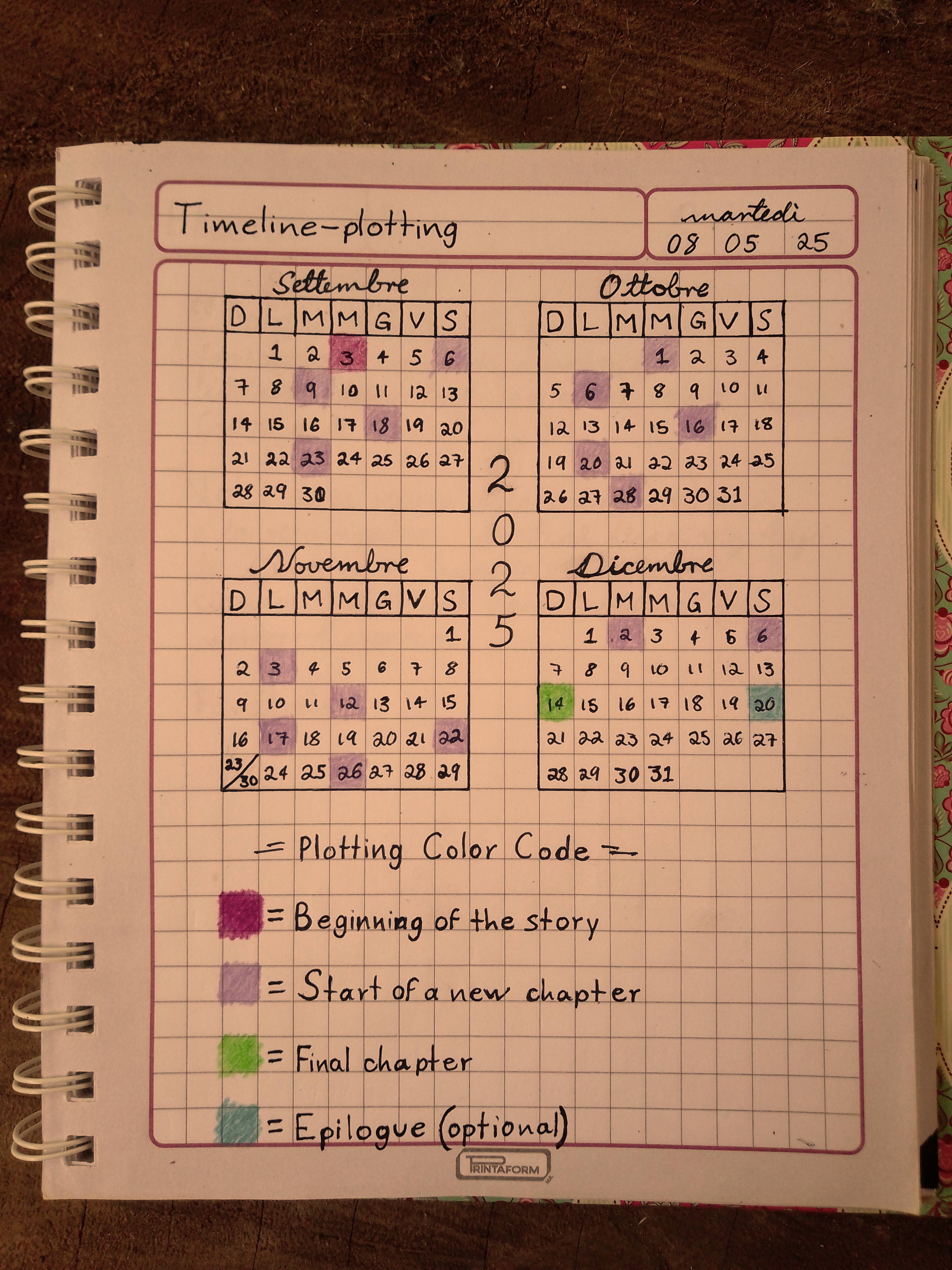
Whether you look for a calendar online and print it or make it yourself—I recommend a grid notebook in that case—our basis is a calendar of the year or years in which your story takes place. If your story spans no more than two years, I encourage you to create it yourself. It can be fun and further stimulates creativity. But if your timeline is ten years or more long—like in Jane Eyre, for example—then it’s more practical to find your calendar(s) online, print them out, and paste them into a notebook.
For this specific case, I chose to make it myself. The image below is actually the second attempt, haha; the first draft was the one I improvised a few weeks ago. But now I’m presenting a random example that has a cleaner and more understandable presentation—the first one was full of scribbles and terrible, compulsive handwriting.
Color code
Just like in the pre-chaptering, I also used the color + meaning method here.
I’ve given my own meanings to the colors, but you can make your own list of colors and assign them whatever meaning you like. The only thing I would recommend is that if you do pre-chapter, try to keep the meanings for your colors more or less the same. That way it doesn’t become so confusing and you can move forward more quickly instead of trying to remember the meaning of each color or looking for a different one.
Start filling in the blanks
Once you have your calendar(s) handy, all you have to do is grab your colored pencils or crayons and get to work.
I had to improvise this method because while I was pre-chaptering, I was getting really confused about the dates of each chapter. How many days passed between the events of chapter three and those of chapter eight? If the story starts in early autumn, how many months would be reasonable until a certain event takes place?
These and other questions were easy to answer once I started “placing” each chapter in its respective spot on the timeline.
If you’re not someone who does detailed chapter planning—like me—don’t worry. You can adapt. For example, once you’ve assigned meaning to your colors, you can make notes on another sheet of paper and mark the important points on your timeline at the same time as you associate those notes with the dates on your calendar. The core of the method remains the same: color + meaning. From there, you can modify it as much as you need. The only thing to remember is that the system should adapt to you, not the other way around. If something isn’t helping you, discard it and find another approach. Don’t confine yourself to a box if you have the freedom to fly.
Last but not least, a novel doesn’t always require you to explicitly state the day. Most of the time it’s completely irrelevant to the reader, but for you, the writer, behind the scenes, it’s important to know the when, the how, and the where. Perhaps not in detail, but at least to have a general idea.
My best advice for knowing whether or not to reveal to your audience the day the events take place?
Write as much as you can and listen to your novel, not to the noise of the world.
Background music
I'm a music addict. We won’t deny that. And I know you are too. So, in case you're also inspired by it, here's the playlist I created especially for timeline plotting. This time it’s considerably longer than the last one, which makes no sense because outlining takes three or four times as long as timeline plotting, but whatever. Hope you enjoy it!
𝄞 So Long, Farewell…
Auf widersehen, adieu 𝄞
I don’t really know what to say here, but the truth is, it feels like a crime for me not to say goodbye. Or at least wish you a good day. So, I hope this post has been helpful for you, and having said that, I wish you a wonderful day.
Thanks for reading and see you next time!
Derrière les lettres,