

A/N: Thanks for the inspiration for this post, you know who you are ;)
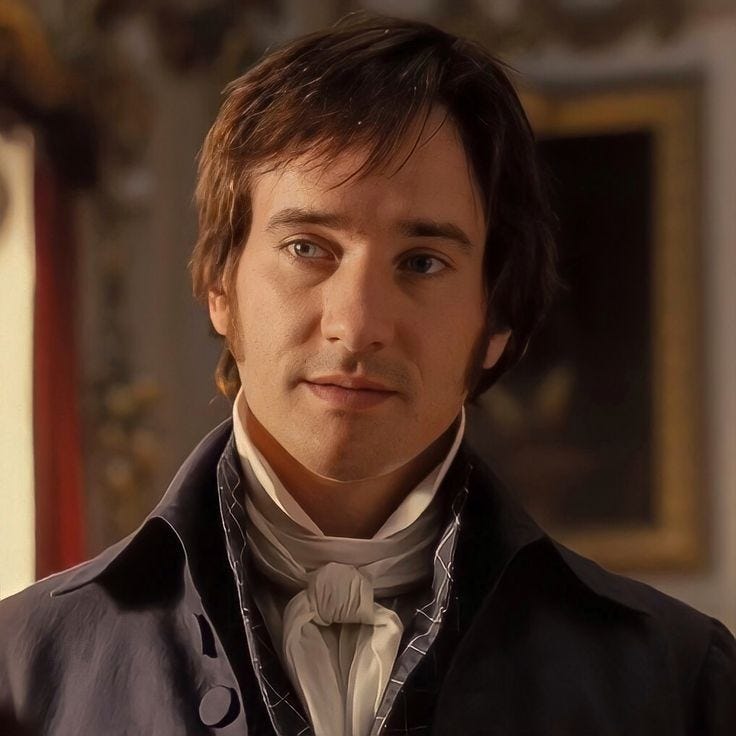
Today I'm going to speak in the voice of a passionate fangirl, so think twice before reading on. If you feel like I'm being too intense, don't stick around! Go read something you enjoy, not something that makes you uncomfortable. That being said, let's move on.
Mr. Darcy is every woman's literary man, isn't he?
But why?
Pride and Prejudice has the enemies-to-lovers cliché, and many people love that intensity, the pure hatred, the desire to make life miserable for the other person, the thin line between hatred and love, so that later, after half a war novel, the tension breaks in a moment of crisis and it ends up being a sweet romance. I think women especially love this cliché.
The standard of the male role in this cliché is usually the same: first he fights the girl, he does his best to break her war spirit, but she is a rock, she doesn't give up; then someone else manages to really hurt her, and the antagonist spreads a flag of peace to wipe her tears, then he goes and fixes that thing that made his favorite enemy cry, the girl feels protected and starts to see her enemy in a different light, the man does the same and then, from one second to the next, they discover that they are soul mates, that they like each other and that they are going to spend the rest of their lives together. That is the standard of the enemies-to-lovers cliché, but each character develops his role differently, and today I would like to talk about how Jane Austen's Darcy does it.
First there is the famous ball scene where Mr. Darcy and Elizabeth Bennet meet for the first time. Elizabeth overhears Darcy telling his friend Bingley that he thinks she is pretty but not pretty enough to dance with. I don't really consider this a fault of Darcy's, I mean, no one can force him to dance with someone if he doesn't want to, but the fact that he says he won't do it for something as superficial as physical appearance shows me where his thoughts are. As the story progresses Darcy starts to look for all the faults of Elizabeth as well as the Bennet family, expressing how much he dislikes them and how undignified he considers them. I think the first thing Darcy finds attractive in Elizabeth is that she is the first one who doesn't fall on her knees in front of him for his money. Elizabeth is the first one who tells him to his face that it is useless to have so much money and possessions if he is not capable of respecting others.
I've heard some girls say that when Darcy insults the Bennet family and belittles Elizabeth it's his way of telling her that he loves her. And the bad thing isn't that girls say it, but that they celebrate it and use it to justify the way Darcy behaves. I'd like to know in what twisted world an insult is an appropriate way to show love and respect. I'm not surprised when I hear these kinds of thoughts that girls have so much trouble believing that they deserve better or believing that there are men of worth and honor in this world. I've also heard people say "you deserve a Mr. Darcy in your life." No! You deserve better than a Mr. Darcy! There are better prospects than someone who is proud and disrespectful.
Don’t get me wrong, I don’t hate Mr. Darcy –I used to– nor do I consider him a useless character because if I did, Pride and Prejudice wouldn’t have been so successful. However, what I dislike so much is that so far I’ve only met women who consider Darcy “the perfect man.” Darcy has a good ending, in the end he has the courage to ignore what others say, redeem himself and follow his feelings for Elizabeth, but that’s where it all stops being charming for me. What scares me is that Darcy makes his decisions based on what he feels, following his emotions. What happens if one day he argues with Elizabeth, gets carried away by his emotions and ends up ruining his marriage forever? And I say forever because when you follow your emotions they take you where they want them to go, on the other hand when you follow something that doesn’t change, the constant North Star for example, no matter how many times you get lost you can always find your way back.
On the other hand, we have Mr. Knightley, who is another Austen character. In her novel Emma, Austen develops another love relationship based on conflict, but this time in a different way. The protagonist, Emma, finds herself constantly arguing and debating with her FRIEND Knightley, who gladly plays along because besides spending more time with her that way, he also enjoys defending what he believes in regardless of the opinions or disagreements of others. Although Knightley often argues with Emma and they have big disagreements, he never, ever uses insults as a sign of affection; his goal, on the contrary, is to try to make Emma a better person. His methods may not be the best, because it is true that he is very hard on Emma and that often all he does is point out her mistakes, but we cannot deny that his desire for purity and righteousness is authentic.
Now, I'm not saying that having emotions is wrong, because being insensitive is not part of human nature, but when we let ourselves be carried away by what we feel instead of thinking sensibly, things can end very badly. Why does Knightley want Emma to be a better person? Because he wants to see her grow and mature for her own good, he wants to see her be a help to others and not a nuisance to society. Personally, I would have liked him to point out her mistakes and also show her why it's good to fix those mistakes and try to do better next time. There is a scene where he does this, but I think Emma wouldn't have had so much trouble admitting her flaws if Knightley had treated her with a little more empathy. Regardless, Knightley wanted the best for his friend.
Darcy, on the other hand, only wants Elizabeth to change for his benefit. He wants her to stop being proud so he can handle her the way he wants. He doesn't care about her performance in society and what she represents as a woman. All he cares about is that when he's with Elizabeth she acts according to his wishes. If that isn't pure selfishness and contemptuous whim, I don't know how else to describe it.
On top of that, I think the concept of writing romance has been terribly misrepresented over the last two or three decades, not to mention that it's been a long, slow process since the fall of man. I think one of the problems with romance writing today is that female authors use writing to dump all their romantic fantasies. I mean, that's what diaries are for, right? People have stopped keeping diaries, dumping all their PERSONAL thoughts and feelings just for themselves, unfettered and unashamed, and since that doesn't exist anymore, female authors today confuse writing fiction with the private act of confessing everything we long for, hate, fear, love or despise. They FILL their writing with sweet dialogues, tender scenes and hopes that, admittedly, are dead. Then girls read all that stuff and think that's the meaning of love, when in fact romance and love serve two very different purposes.
Reading romance is fun and entertaining, of course it is, but in the end it doesn't satisfy me. What good are all those smiles if they're fake? It's not someone real who's causing them, so the feelings those smiles represent can't be real. I find a romance that makes me cry even more authentic than one that makes me smile, because if it makes me cry it means the story managed to touch something inside me that needed to come out. But smiles are sacred, and I firmly believe that a fake smile is worse than lips that never smile. Maybe it works for others, and it's a good thing it does, but it doesn't help me to read romance if all it leaves me with is a bitter feeling of envy. Because besides fostering erroneous ideas of an idealized and unreal world, a book that has romance as its main theme is a book that, I believe, is exposing a part of life that is private and sacred between two people, something that shouldn't be public knowledge.
I'm not going to pretend, my three favorite books all have romance. But I think one of the reasons I like them so much is because in none of them romance is really the main purpose, I know that for many it would be, but not for me. There is much more to understand, process and absorb in these stories than just a romance that at the end of the day most of us have already experienced or will experience firsthand according to our faith, standards, and expectations, and I think that is what Austen wanted to convey in her novels no matter how perfect or imperfect her characters were. However, I think it is worth emphasizing that just because a story teaches us something good does not mean that its protagonist should be our role model.
A great example of this is The Phantom of the Opera.
⚠️SPOILER ALERT⚠️
Erik’s story teaches us that there is redemption, that in the end we can always do the right thing, but Erik is not even close to an admirable character. And I don’t mean that because of his physical ugliness, but because of the rotten soul he had, because of his dark, selfish and macabre intentions. It is not until the end when, upon receiving the greatest gesture of empathy he has ever received, that Erik decides that he will let Christine be happy with the man she loves. In the end, as I say, he decides to do the right thing, but his behavior in the rest of the story is truly despicable, it is something that should not be taken as a standard of acceptance. I think there is a difference between what the story tells on its own and what the character, as a representative of humanity and its characteristics, demonstrates or promotes. That is why I do not consider Darcy to be the perfect literary man that the vast majority of women say he is.
Knightley may not be the most “romantic” man by today’s standards –he doesn’t think to give Emma gifts, he doesn’t shower her with flowers and chocolates, he doesn’t take her to fancy places, and he’s definitely not perfect either– but at least he’s a better role model. His conduct throughout the book is decorous, respectful, honorable, and judicious. He looks out for the good of others and not his own, he rejoices in the successes of others, and he respects, even within their mistakes, the decisions of others.
Why is Knightley better than Darcy? Because he has his standards higher than the girl, because Knightley doesn’t act thinking about what she wants but about what is right and necessary, even if that could apparently drive Emma away from him —because the truth is that at the end of the day that is what unites Knightley and Emma so much. Knightley is a man of convictions, Darcy is an insecure child who follows his emotions. Both can teach us great things, but I doubt that anyone will ever convince me that it is better to admire a man who knows how to be “romantic” than a man who is true to his convictions and who knows how to defend them with wisdom and respect.
I read these two books a long time ago and I don’t remember all the details, I can’t tell you exactly specific scenes or whole dialogues, but I do remember what I felt and thought when I read them… maybe I should read them again, to get a second impression, write another article and compare one to the other… Writing this while listening to the Backstreet Boys feels unreal. I mean, what does pop culture have to do with classic 18th century literature besides both being part of art and history? Thanks mom for making me read, thanks uncles for feeding my musical tastes I guess.
What do you think? Is Darcy as perfect as we've always believed? Is there any salvation for him? Do the story and the character have the same purpose and/or meaning? I love to debate, so feel free to comment whatever you think about it. I'd love to hear what you have to say!
Behind the letters, a girl 🌹
P. S. If you've made it this far, you're invited to my funeral, I won't be around long after Darcy fans discover this newsletter. You can wear whatever color you want, just remember to bring your own cup for toasting. I won't let you toast with anything but coffee!
Random tip: Do not just smile, find a reason to smile. Actions come and go, but convictions and purposes will last a lifetime. 😊
My impressions of Darcy are similar to your own so there will be no heated debate vis-à-vis Knightley & Emma😊! But, I will deliver my thoughts on Darcy. Mr. Darcy is very stubborn, controlling, not one to enjoy fun, and afraid to show weakness. All of these characteristics we share and employ in our lives at one time or another, but for Darcy these were the driving forces that made him who he was as a person. It is what made him tick. Darcy's sneaky meddling between Bingley and Jane establishes who he truly is. That's something that is key for me. Observing, even in literature how characters treat others exposes a great deal of who they truly are, and even if they try to conceal it, evidence is there if we look carefully. Knightley is honorable, outgoing, and very direct. He wants the best for others, and this is seen throughout how he interacts with others. His advice and wanting to help even if he tried to hide these qualities would still be visible. Why? Because that is the root of who he is. That’s how he treated others. As far as the Backstreet Boys go, I suppose the envelope of romance awaiting to open our hearts is something that beholds to 18th century literature. Nice connection 😊 This is very well thought out, and passionately written. Perhaps, “Larger than Life”🎵 Worth the wait indeed!!!
I ABSOLUTELY ADORED THIS!!!!!!!! Jane Austen is amazing! Her characters are amazing! The plots are amazing!!!